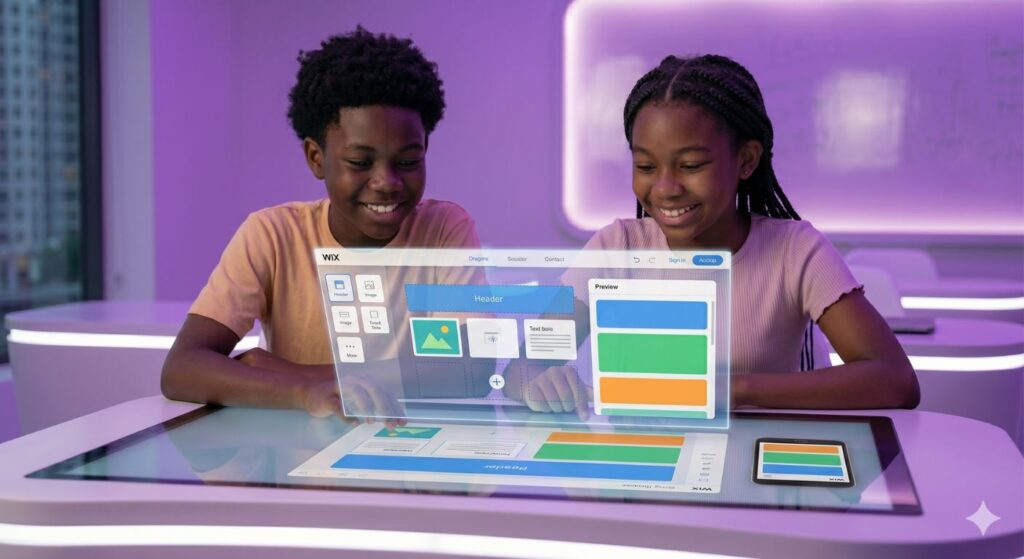

AI & CODING FOR TEENS
Web Development for Young Learners
A 4-week live online programme where children aged 10–16 design, build, and publish a real website — learning HTML, CSS, and JavaScript through hands-on projects and AI-assisted coding tools designed specifically for young learners.
They Will Build a Website That Is Live on the Internet Before the Programme Ends.
Who Is This Programme For?
- Children aged 10–16 who want to build something real — not just learn about the internet, but create part of it
- Young learners who are curious about how websites are made and want to understand the code behind what they see
- Beginners with no prior coding experience — everything is taught from scratch in age-appropriate language
- Parents who want their child to develop digital creativity alongside technical confidence
Building a website teaches a child that they are not just a consumer of the digital world — they are a potential creator of it. That shift in identity, at 12 or 14, is more valuable than any specific tool they learn along the way. |
Course details:
- 4 Weeks
- Two sessions per week
- Virtual Instructor-Led Training
- KES 15,000
- Certificate of completion

KES 15,000
What You Will Be Able to Do
- Build and publish a complete, real website with their own design, content, and domain
- Write HTML to structure web pages the way professional developers do
- Use CSS to style pages with colours, fonts, layouts, and spacing they chose themselves
- Add JavaScript to make pages interactive — buttons that respond, content that changes
- Use AI tools like ChatGPT as a coding companion to get help and fix mistakes
- Understand how the internet works and how websites connect to it
Course Curriculum
Week 1
How the Web Works and Your First Web Page
What happens when you type a URL and press enter — explained for a 12-year-old. Browsers, servers, and HTML files. How they connect. Your child will have a working HTML page visible in a browser, with their name on it, before the first session ends.
Week 2
CSS: Making It Look Good
Colours, fonts, spacing, and layouts. This is where the page stops looking like a plain document and starts looking like a real website. Learners choose their own colour schemes, pick their own fonts, and arrange content to reflect their personality. By the end of this session the page looks designed — because it is.
Week 3
JavaScript: Making It Do Things
Buttons that respond when you click them. Text that changes. Simple games that run in the browser. Introduction to events and how code reacts to what a user does. This is the session where learners first realise how much of what they see on the internet is just JavaScript doing its job.
Week 4
AI Tools and Final Project
Using ChatGPT, GitHub Copilot, and Replit AI to get coding help, debug problems, and generate creative ideas. Then the final project: assembling everything into a complete personal website or small creative project, published live to the internet, and presented to the group — with parents invited to the demonstration.
Tools Your Child Will Use
Web Languages
HTML5
CSS3
JavaScript (basics)
AI Coding Tools
ChatGPT (coding help and ideas) Replit AI (built-in assistant) GitHub Copilot (introduction)
Editors
Replit (browser-based, no install) VS Code (introduced in week 3)
Publishing
Web hosting platform
Domain setup (guided in week 4)
Testimonials
What Parents and Learners Say
We enrolled our son in Python first and he enjoyed it so much that we signed him up for Web Development as well. The two programmes worked well together and helped him build on what he had learned. By the end he had a portfolio site that even showcased the Python game he created and his teachers were genuinely impressed.

I am 15 and had always wanted to build websites but the tutorials I found online were too confusing to follow. This programme started from the basics and everything was explained in a way that made sense to me. I now have my own website and I am already excited about what I want to build next.
I enrolled my 13 year old daughter so she could do something productive during the school holidays. I did not expect her to finish with a real website live on the internet that she could proudly share with her classmates. The confidence she gained from the experience made it far more valuable than I had anticipated.
FAQ's
Frequently Asked Questions
No prior experience at all is required. This programme starts from the very beginning — what the web is, what HTML is, and why it matters — before any code is written. If your child has done our Python programme, they will find some concepts familiar, but the two programmes are completely independent.
Yes. Publishing the website is a core part of week four. Every learner leaves the programme with a live URL — a real website on a real domain, accessible from any device. This is not optional and it is not a demo environment. It is a real published site.